The Junk Drawer Audit: How Much Money Is Hiding in Your Kitchen?
By Matt S
The Junk Drawer Audit: How Much Money Is Hiding in Your Kitchen?
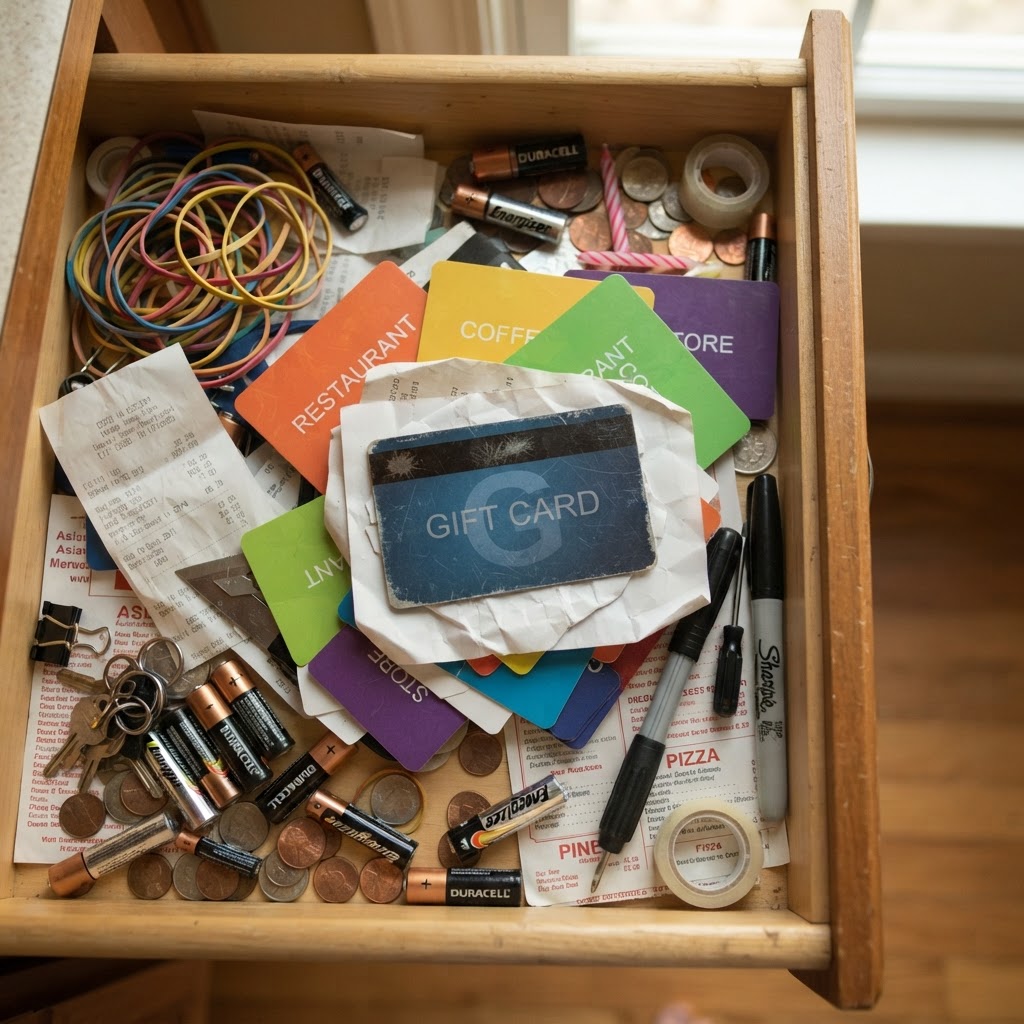
There is money in your kitchen right now. Probably not in the flour jar. More likely in the drawer you only open when the tape dispenser is missing.
People who have taken the Forgotten Gift Card Challenge on our site have found a combined $82 sitting around their own houses, often in the first five minutes of looking. That is a nice dinner out, a tank of gas, or a genuinely embarrassing amount of gummy bears, depending on your priorities.
The audit below takes two minutes. Here is how to run it.
Step 1: The sweep
Check the usual suspects: the kitchen junk drawer, your wallet, the glove box, the bowl by the front door, old purses, coat pockets. Then check the place most people forget: your email inbox. E-gift cards are the forgotten frontier. Search your email for the words "gift card", "redeem", and "congratulations" and see what turns up.
You are looking for gift cards in any condition: shiny, bent, sticky, or mysteriously warm. All of them count.
Step 2: Check each balance
For each card you found, look up the balance on the retailer's own site or app. If a retailer does not offer an online balance check, the phone number on the back of the card will.
One caution: use the retailer's official site only. Third-party "balance checker" sites are best avoided. There is no reason to hand a stranger a gift card number.
Some cards will have a full balance. Some will have a sad little remainder like $3.41. Some will be exactly zero, which hurts in a very specific way.
Step 3: Read the fine print
Expiration dates and inactivity-fee rules vary by card and by state, but the general rule is: the clock is not necessarily your friend. Some cards lose value through inactivity fees after a period of dormancy, and some expire outright. Check the terms on the card or the retailer's FAQ page, and note the dates that matter.
This is the step everyone skips, which is how a card quietly goes from $25 to $0 while sitting in the dark next to a birthday candle and a screwdriver.
Step 4: The 30-day use-it-or-lose-it plan
Finding the money is only half the audit. The other half is making sure it does not go back into the drawer to be rediscovered in 2029. A simple plan:
- Week 1: Put any card you will realistically use in your actual wallet or phone, not back in the drawer.
- Week 2: Match cards to errands you already run. Grocery card with the grocery run, coffee card with the coffee you were buying anyway.
- Week 3: For cards to stores you never visit, consider regifting, trading with a friend, or using the card for a gift you needed to buy anyway.
- Week 4: Whatever remains, decide on purpose: use it, give it, or accept its fate with a small ceremony.
Step 5: Prevention
The audit works, but doing it every year is like re-buying the same lost umbrella. The fix is to stop keeping gift cards in places that eat them.
When you get a card, snap it into one place the same day: a wallet app that keeps the barcode, the balance, and the expiration date together. (Full disclosure: I built CardKeep Wallet, a gift card wallet app for Android, after my own drawer audit turned up a card from a store that had closed in 2019. I checked its balance with more hope than the situation deserved.)
One place for every card means the next audit takes zero minutes, because there is nothing left to find.
Want to know how much is hiding in your house? Take the Forgotten Gift Card Challenge.